Lifting industry
higher together
higher together

Engineering
partnerships
for a stronger tomorrow
partnerships
for a stronger tomorrow
Product News
Published on:
4 min read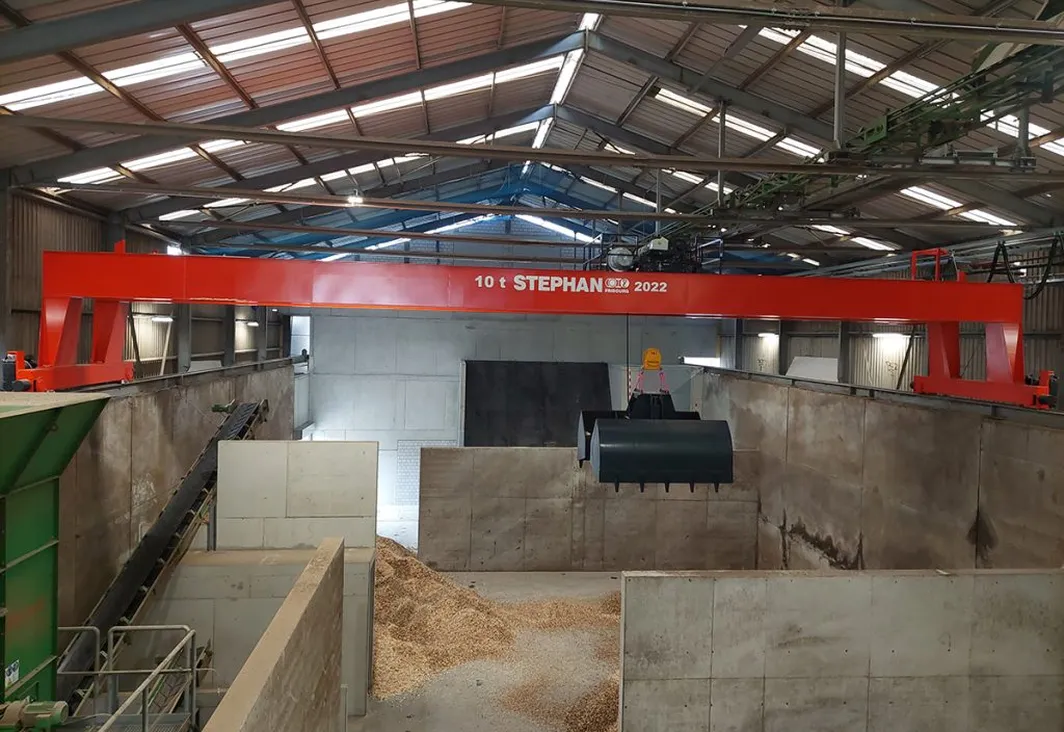
Founded in 1902 and based in Fribourg, STEPHAN SA specializes in structural steelwork, facades, lifting equipment and mechanical welding. Almost 130 people work at its 140 000 m2 site in Givisiez. The company's expertise is well established, built on more than 120 years of serving its customers. STEPHAN has earned a reputation as a trusted partner capable of handling the most specialised projects, covering everything from design through after-sales support, including manufacturing, surface treatment, assembly and commissioning. Because it holds itself to the highest quality standards, STEPHAN keeps investing in its production facilities. It carries the most demanding certifications across several fields and partners with manufacturers known for product quality — VERLINDE among them, having supplied its lifting equipment for close to 30 years.
One of STEPHAN's customers buys wood chips wet from foresters, dries them, then sells them on dry to biomass heating plants. The energy this biomass generates is renewable and CO2-neutral, making smart use of organic waste and local raw materials like wood. Turning biomass into energy is a rapidly growing sector in Switzerland. As Mr. Chevalley, STEPHAN's Industry Manager, puts it: “Given today's environmental concerns, biomass energy production is one of the solutions of the future, and this kind of heating system is spreading fast across Switzerland.”
STEPHAN was brought in when this activity launched, to build the overhead travelling crane that distributes chips to different areas throughout the drying process. The crane runs automatically under PLC control, drawing on data fed back from sensors positioned at various points along the production line.
Forestry workers tip the chips directly into a first hopper, where probes track the height of the piles. Once a pile reaches a set fill level, the crane transfers the material into storage areas assigned according to chip quality. From there, the chips move on to the dryer as space allows. Once dried, the crane relocates them to a storage area that likewise fills according to demand. STEPHAN partners with another company for the crane's automation: that partner supplies the management software, while STEPHAN SA handles installation of the sensors and control cabinets.
For this job, STEPHAN needed a winch for the overhead crane that could sustain high output over long runs at high speed: the hall housing the production line spans 65m x 23m and stands 16 meters tall. Although the overhead travelling crane itself is a new installation, it sits inside an existing building — a former tile factory converted for its new purpose. Layout constraints came into play too, notably the crane's height, which had to be optimized for storage volume. STEPHAN turned to VERLINDE, its long-standing partner, to supply the winch and end carriage.
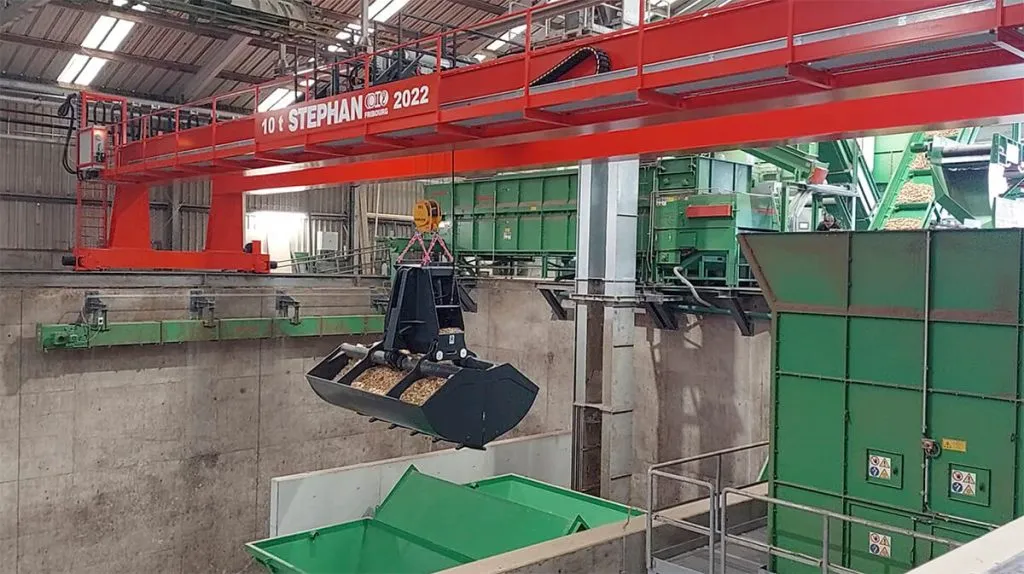
VERLINDE put forward a winch from its PDW range to cover the application's demanding performance and speed needs. The VERLINDE PDW family of open winches targets heavy-duty use, spanning 6,300 to 70,000 kg. For this chip producer, the overhead travelling crane runs at 80 m/min front-to-back, 50 m/min right-to-left, and 30 m/min when lifting, handling loads of up to 10 tonnes including the grapple.
FEM M7 duty class comes standard, whereas some competing models would need hours of extra development — a difference that saves on engineering costs. “The savings from fitting the PDW winch let us give our customer a competitive offer, while still supplying a product known for its quality and performance,” said Mr Chevalley. “STEPHAN had already designed and installed around a dozen similar, smaller setups, though never with this particular VERLINDE winch model. Here, the PDW winch ticks every box: it can move a large chip volume of 180 m3 per hour, delivers high lifting capacity and speed, and satisfies the M7 mechanism group requirements. It gives us a strong reference and a springboard for future equipment sales in this promising market,” he concludes.