Lifting industry
higher together
higher together

Engineering
partnerships
for a stronger tomorrow
partnerships
for a stronger tomorrow
Passive sway control steadies the load during trolley and/or bridge travel for smoother, safer handling. It adjusts acceleration and deceleration to reach the operator’s requested speed with minimal sway and less residual oscillation once stopped.
A mathematical algorithm drives this feature, shaping motion ramps according to the load height that's been measured (pendulum length).
Shock load prevention allows smooth load pick-up: the hoist drive monitors the load, and if it senses a sudden change (as slack chains or slings pull taut) it automatically slows until the load is fully lifted. Once the load is under control, hoisting speed is no longer restricted, protecting the crane and building from shock loads.

When lowering a load with a lifting device attached to the hook(s), operators need to pay close attention to where the load finally comes to rest.
Slack rope prevention senses when the load reaches its final position and automatically halts the lowering movement. The hoist drive compares a preset load value against the actual lifted load, keeping the hoist ropes from going slack and helping prevent the lifting device from falling or tilting. This gives the operator better control over the lifting device and lowers the risk of dangerous situations.

Load floating holds the load securely in the air for a set time once hoisting stops, without applying the mechanical brake. The hoist motor instead maintains the needed holding torque at zero speed, keeping the brake open.
Because there’s no brake “grab” to fight through, restarts become quicker and smoother, giving the operator far more precise load control. Unnecessary brake use also drops, which cuts mechanical brake wear, extends component lifetime and supports more efficient operations overall.

Micro speed sharpens load control precision. This function converts large joystick movements on the operator interface into slow, precise load movements — especially useful for final load positioning, keeping operations safe while protecting valuable loads.
Micro speed can be applied to all motions (hoist, trolley and bridge). The maximum speed of each movement is scaled to a chosen value between 1 and 99%. A value of roughly 30% is typically selected to limit the overall speed range.

Inching feature offers a way to approach a load destination with great precision, letting the crane operator make small movements one step at a time. Once Inching is activated, movement stops after covering the set inching distance, enabling very precise load placement, reducing collision risk and boosting productivity. Inching applies to both hoisting and travelling motions.
When a crane has two main hoists, it can be necessary to run both at once. With Hoisting Synchronization mode active, the two hoists start and stop together, keeping the load aligned as it was when hoisting began. This works even if the load isn't equal on each hook.
This feature relies on knowing the position of both hooks. During operation, the difference between their positions is continuously monitored and controlled.
Hoisting synchronization simplifies load handling, making it faster and safer.
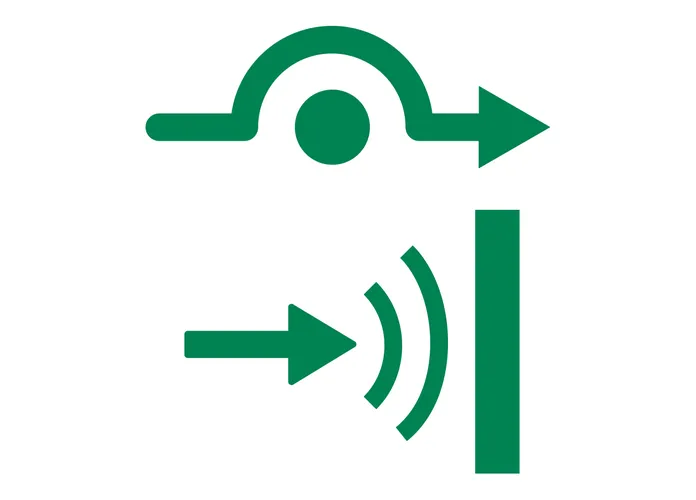
The anti-collision device stops hoists on the same bridge from closing in on one another at high speed.
Each direction requires one sensor, and the opposite hoist needs a reflector. The detector is typically wired to the slow-down circuit, letting the cranes approach each other at low speed.
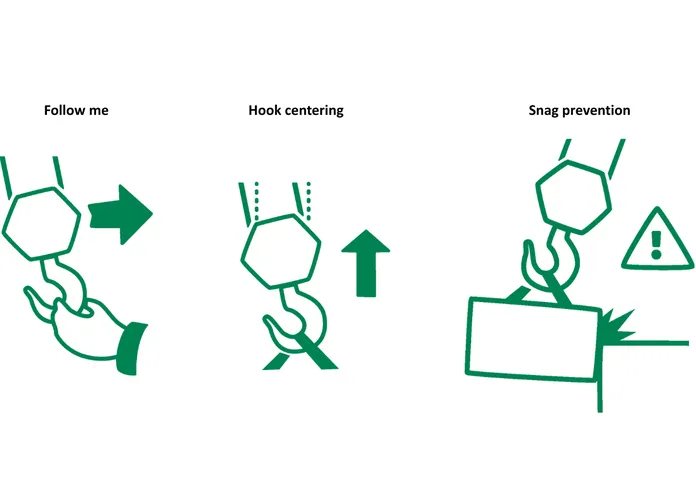
Rope angle features guard against side pull, cutting rope wear and protecting key crane components, while also making operation feel more intuitive, lowering operator error and lifting overall productivity.
Three rope angle features are offered:
Follow Me: just guide the hook by hand and the crane follows effortlessly, for smooth and precise positioning.
Hook Centering: as lifting begins, trolley and bridge are automatically aligned by the system to remove rope angle, giving a straight, controlled lift-off.
Snag Prevention: should the load or hook accidentally catch on something while travelling, movement is halted by the system, helping prevent damage and keep operations safer.
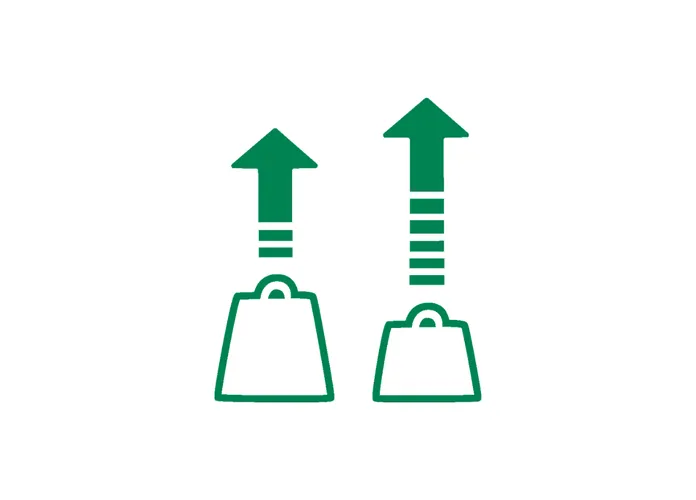
Extended Speed Range allows a higher speed than the hoisting motor's rated speed. ESR speed applies when the load is below the hoist's rated capacity. ESR is used only for hoisting movement, not for travelling.